Introduction
A 3PL, or third-party logistics provider, is an outside company a brand owner hires to store inventory, pick and pack orders, ship them to customers, and process returns — the physical supply chain, run by someone else. For a brand owner the trigger to hire one is not a specific order count: it is the point at which fulfillment work starts displacing product, sales, and compliance work. Most medical product brand owners start the same way, packing orders themselves and keeping inventory in a spare room or rented space, until orders pile up faster than they can pack them, storage becomes chaotic, and compliance paperwork multiplies. Blue Bonnet Supplies is the official US warehousing and logistics partner of Ultrahuman, and this guide is written for exactly that growth moment.
For medical product businesses, the stakes are higher than for most other industries. Unlike apparel or consumer goods, medical products come with regulatory requirements: FDA documentation, proper labeling, and controlled storage conditions that a standard logistics setup may not be equipped to handle.
One missing document or improper label can mean shipments held at customs, distributor rejections, or regulatory violations that put your business at risk.
A 3PL is not the same thing as a shipping carrier: a carrier moves a package from pickup to delivery, while a 3PL receives your inventory, stores it, picks and packs each order, hands off to the carrier, and processes the return when it comes back. This guide explains how that works step by step, what services are included, and how to tell if you need one—with specific attention to what medical product businesses should look for.
Key Takeaways
- A 3PL stores your products, fulfills orders, and handles shipping on your behalf
- From receiving inventory to picking, packing, shipping, and processing returns — the 3PL manages the full order cycle
- For medical products, a 3PL must meet FDA, ISO, GMP, and HIPAA-safe handling standards—or risk delays and violations
- Using a 3PL frees you to focus on growing your business while warehousing, shipping, and compliance are handled for you
What Is a 3PL?
A third-party logistics provider (3PL) is an external company you hire to manage the physical side of your supply chain—warehousing, order fulfillment, packing, and shipping—so you don't have to do it yourself.
Understanding "Third-Party"
The term "third-party" refers to the relationship structure:
- First party: Your business
- Second party: Your customer
- Third party: The logistics company handling the movement of goods between you and your customer
3PL vs. Shipping Carrier
Using a shipping carrier like UPS or FedEx is just one piece of the puzzle. A carrier transports packages from pickup to delivery—that's it. A 3PL manages everything upstream: receiving your inventory, storing it in a warehouse, picking and packing orders as they come in, then handing off to the carrier for final delivery.
3PL vs. 4PL
A 4PL (fourth-party logistics provider) is a management layer that oversees multiple 3PLs and focuses on supply chain optimization across your entire operation. A 3PL, by contrast, is the hands-on operational partner handling your goods. For most brand owners—especially those just scaling up—a 3PL is the relevant choice.
Not Just for Large Businesses
Many brand owners assume 3PLs are only for large enterprises. That's a misconception. 87% of shippers report increasing their use of outsourced logistics services, with businesses of all sizes outsourcing 61% of warehousing and 82% of transportation expenditures.
If managing inventory, packing, and shipping is consuming time you'd rather spend on sales or product development, that's the signal—not your order count.
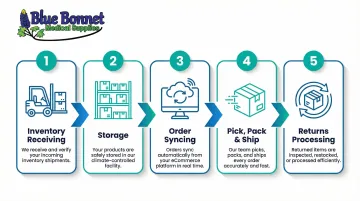
How Does a 3PL Work, Step by Step?
Here's what the process looks like from the moment your inventory arrives to the moment a return lands back on the shelf.
Step 1: Inventory Receiving
You ship bulk inventory to the 3PL's warehouse. The team unloads it, counts it, inspects it, and logs it into their warehouse management system (WMS).
For medical products, this receiving step includes compliance checks:
- Verifying lot numbers and expiration dates
- Inspecting packaging integrity
- Confirming documentation matches the shipment
- Logging items according to regulatory tracking requirements
Step 2: Storage
The 3PL stores your inventory in organized locations tracked by their system. Every item has a designated spot, and the WMS knows exactly where each SKU is located.
Medical products often require specific storage conditions that general warehouses don't provide:
- Controlled temperature and humidity environments
- Segregated storage for regulated items
- Clean, organized spaces that meet FDA and ISO standards
Without proper storage, medical products can degrade, lose compliance status, or fail inspections.
Step 3: Order Syncing
The 3PL connects to your sales channels—your website, Amazon, and other platforms—so when a customer places an order, it flows automatically to the warehouse. There's no manual entry or spreadsheet forwarding involved — the order appears in the 3PL's system the moment it's placed.
Step 4: Pick, Pack, and Ship
The warehouse team picks the correct products from inventory, packs them according to your brand's requirements and any compliance packaging standards, then ships via the most appropriate carrier.
3PLs with established carrier relationships often secure better shipping rates than individual brands can negotiate. Organizations using Warehouse Management Systems see inventory accuracy increase by an average of 20%, reducing errors and improving customer satisfaction.
Step 5: Returns Processing
Returned items come back to the 3PL warehouse, where they're inspected and either restocked, flagged for disposal, or—for medical products—assessed for restoration or testing before re-entering inventory. For medical brands, this isn't just a logistics step — it's a compliance safeguard that keeps unsafe or expired products out of circulation.
What Services Does a 3PL Provide?
Core Services
Most 3PLs offer these baseline services:
- Warehousing and inventory storage
- Order fulfillment (pick, pack, ship)
- Returns management
- Real-time inventory reporting
Any 3PL worth partnering with should cover all four without exception.
Shipping and Carrier Management
3PLs typically maintain direct relationships with multiple carriers, routing shipments based on cost, speed, or destination. That includes international shipping. For medical products going overseas, a 3PL with customs compliance experience is essential — shipments without proper documentation can be held, rejected, or trigger regulatory issues.
Value-Added Services
Many 3PLs go beyond basic fulfillment with services like:
- Kitting and assembly (bundling products into ready-to-ship configurations)
- Custom packaging
- Product labeling
- Quality control checks
For medical brands, these extras often aren't optional — specific labeling requirements and bundled configurations are frequently mandated by distributors or regulators.
Compliance-Specific Services for Medical Products
Medical product shipments require:
- FDA-cleared packaging
- HIPAA-safe handling
- ISO and GMP compliance
- Proper documentation for customs and regulatory bodies
Effective February 2, 2026, the FDA's Quality Management System Regulation (QMSR) incorporates ISO 13485:2016 by reference, meaning medical device 3PLs must align with strict controls for product preservation, traceability, and labeling.
Medical products that don't meet regulatory requirements can be delayed at customs, rejected by distributors, or create legal liability for your brand. Blue Bonnet Supplies handles these requirements as a standard part of its service — FDA clearance, ISO compliance, GMP compliance, and HIPAA-safe handling are built into every client engagement, not offered as add-ons.
Key Benefits of Using a 3PL for Your Brand
Cost Savings
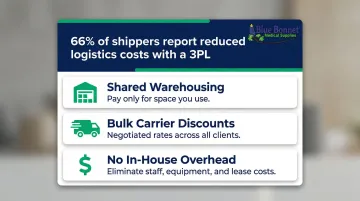
3PLs reduce logistics costs in ways individual brands cannot achieve alone. 66% of shippers report that 3PLs contribute to reducing overall logistics costs through:
- Shared warehousing space (you pay only for what you use)
- Bulk carrier discounts negotiated across all their clients
- No overhead for in-house fulfillment — staff, equipment, or leased space
Time and Focus
When you're packing boxes and chasing tracking numbers, you're not working on product development, marketing, or sales. A 3PL removes that burden entirely, freeing you to focus on the work that actually grows your business.
Tasks a 3PL takes off your plate:
- Receiving and storing inbound inventory
- Picking, packing, and labeling outgoing orders
- Managing carrier relationships and tracking shipments
- Handling returns and restocking
Scalability Without Infrastructure
A 3PL absorbs volume spikes — seasonal demand, product launches, new channel expansion — without you having to hire staff, lease more space, or buy equipment. For medical brands moving into new sales channels or international markets, this flexibility is particularly valuable given the compliance requirements involved.
That scalability also shows up in service quality: 82% of shippers agree that using 3PLs contributes to improved customer service, which translates directly to better reviews, repeat customers, and a stronger brand reputation.
Signs It's Time to Switch to a 3PL
Operational Bottlenecks
You're spending more time on fulfillment than on growing the business. Orders are shipping late. Errors are increasing as volume grows. These are early warning signs that in-house fulfillment is no longer sustainable.
Storage and Space Constraints
Your storage space is running out. Inventory is disorganized. You're storing products in locations—like a garage or office—that aren't appropriate for the products. For medical items that need proper storage conditions, this creates both operational and compliance risks.
Compliance Exposure
For medical product brands, shipping regulated products without proper compliance infrastructure carries real consequences:
- Products held or rejected at customs
- Distributor rejections due to labeling issues
- Regulatory inquiries and documentation failures
The FDA's Import Alert 99-49 authorizes detention without physical examination for devices missing a required UDI label or GUDID record. If your current setup can't guarantee proper documentation, labeling, and handling, it's time to find a 3PL built specifically for medical products.
How to Choose the Right 3PL for Medical Products
Industry Specialization Matters More Than Size
A large general 3PL may not have the protocols for medical product handling. Ask potential 3PL partners directly:
- Do you have experience with regulated products?
- What certifications do you hold?
- Can you provide references from other medical product brands?
Treat FDA compliance, ISO certification, GMP practices, and HIPAA-safe handling as baseline requirements for any medical product 3PL. The FDA's Quality Management System Regulation (21 CFR Part 820) covers the packaging, labeling and storage of finished devices as well as their design and manufacture, so ask which of those controls touch your inventory and how the 3PL documents them.
Evaluate Their Compliance Infrastructure
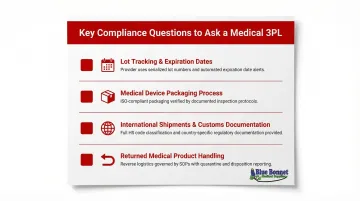
Dig into the specifics. A qualified partner should answer these questions with documented processes, not vague reassurances:
- How do you handle lot tracking and expiration dates?
- What's your packaging process for medical devices?
- How do you manage international shipments and customs documentation?
- What happens when a returned medical product arrives?
A 3PL that answers these questions with real examples and written procedures is prepared for the realities of medical product logistics.
Personal Fit and Customization
Not every brand fits the same mold. A 3PL that offers customized solutions rather than a rigid one-size-fits-all model will be a better long-term partner.
Blue Bonnet Supplies is one example of this approach in practice. Built around the idea that every business operates differently, they tailor logistics workflows to each client's needs rather than fitting clients into a standardized system. That means things like:
- Custom packaging and labeling processes per brand
- Flexible fulfillment setups for Amazon, direct-to-consumer, or international orders
- Compliance-ready handling without the rigidity of a large-scale generalist warehouse
For medical product brands that need both flexibility and regulatory compliance, those two things working together is what separates a true partner from a vendor.
Frequently Asked Questions
What is a 3PL (third-party logistics) and what does it mean for brand owners?
A 3PL is an outsourced logistics company that stores a brand's inventory, fulfills orders, and handles shipping on the brand's behalf. This allows brand owners to focus on running and growing the business instead of managing physical logistics.
How do 3PL companies make money?
3PLs charge per warehouse event rather than one flat rate: receiving inbound inventory, storage billed monthly per pallet or bin, pick and pack per order, returns processing per item, and shipping. They also generate revenue through carrier volume discounts they negotiate, passing some of that saving to clients and retaining some as shipping margin. Ask for an itemized rate card so every category is priced separately.
Do I need a specialized 3PL if I sell medical products?
Medical product brands need a 3PL with specific compliance credentials—FDA clearance for packaging operations, ISO and GMP compliance, HIPAA-safe handling. Whether the 3PL must itself register with the FDA depends on the role it plays: FDA's list of establishment types that must register and list includes repackagers, relabelers and initial importers. General 3PLs may not have the protocols required for regulated products, which can create customs delays, distributor rejections, or regulatory penalties.
What is the difference between a 3PL and handling fulfillment in-house?
In-house fulfillment means the brand manages its own storage, packing, and shipping using its own staff and space. A 3PL outsources all of that to a specialist. The tradeoff: you trade direct operational control for lower costs, greater scalability, and built-in compliance infrastructure.
When should a brand switch from in-house fulfillment to a 3PL?
A brand should switch from in-house fulfillment to a 3PL when fulfillment work starts displacing the work that grows the business. The usual triggers are the owner's time going to packing and shipping, order errors increasing as volume grows, storage space running out, or expansion into new sales channels or international markets that require compliance capabilities beyond what the brand has internally.